What Are the Top 10 Types of Wire Cable?

Time:2026-11-04 Author:Sienna
0%

Wire Cable selection begins with a simple question: what must the cable carry, and where will it operate? A flexible cord behind a desk faces different demands from a power cable buried underground. Conductor material, insulation, shielding, temperature, and movement all shape performance. The label alone is not enough.

Thomas Edison, the electrical systems pioneer, is often credited with the line, “Genius is one percent inspiration and ninety-nine percent perspiration.” It is not a cable-design rule, but it suits this subject: reliable choices depend on checking details, not guessing. A cable that looks suitable may still have the wrong voltage rating, jacket, or bend tolerance. Small differences matter.

This guide surveys ten common Wire Cable types, from building wire and coaxial cable to fiber-optic cable and flexible control cable. Each serves a distinct job. A coaxial cable carries signals through layered shielding; a building wire must suit its installation and load. These examples are starting points, not universal recommendations. Conditions vary. The right choice depends on the actual application, manufacturer specifications, and qualified technical review. Even experienced buyers can overlook one detail. That deserves a second look.
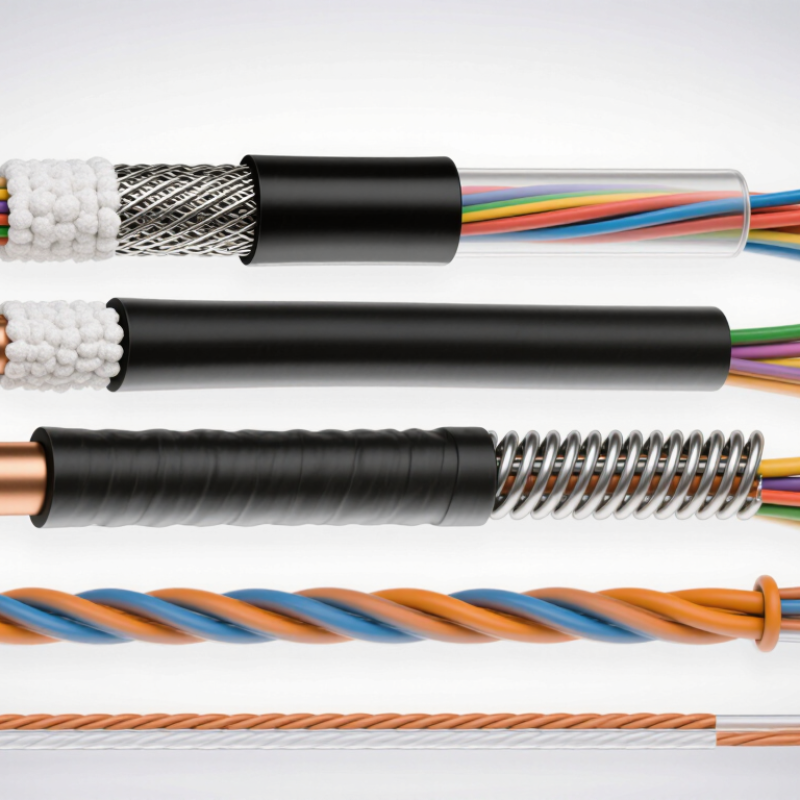
What Are the Top 10 Types of Wire Cable?

How Wire and Cable Differ in Structure and Function

A wire is usually one electrical conductor, either solid metal or a bundle of fine strands. It may have insulation, such as a thin polymer layer, or remain bare for a specific installation. A single insulated wire can carry current between two points, but it offers little protection from crushing, abrasion, or interference on its own. Solid wire holds its shape in a fixed route. Stranded wire bends more easily around a tight corner.

A cable groups two or more conductors inside a shared outer covering. Each conductor may have its own insulation, while the outer jacket helps guard the assembly against moisture, friction, or everyday handling. Some cables also include shielding or strength members, depending on where they are used. Think of a desk lamp cord: several conductors sit together beneath one flexible jacket. That difference matters. A wire describes a conductor; a cable describes an assembly.

The terms are not perfectly consistent across every trade, and product labels can blur the line. Check the conductor count, insulation, voltage rating, and environment before choosing either. A thick jacket does not automatically mean a cable suits outdoor use. Small detail, big consequence.

10 Common Types of Wire and Cable

Representative number of insulated conductors or cores in a typical construction—not a ranking. Actual designs vary.

How wire and cable differ: A wire is generally a single electrical conductor, which may be solid or stranded and may have insulation. A cable is an assembly of two or more conductors or optical fibers, often enclosed in a shared sheath; shielding or armor may also be included. The coaxial-cable count shows its center conductor, not its conductive shield. Fiber-optic cable carries light and has no electrical conductor cores.

The Main Types of Building and Power Cables

Building and power cables differ by location, voltage, and mechanical demands. In homes, nonmetallic-sheathed cable commonly carries branch-circuit wiring through dry wall cavities. Armored cable adds a protective metal layer where wiring faces greater physical exposure. In conduit, individual insulated conductors can be pulled through a defined route and replaced more easily. Service-entrance cables connect incoming utility service to a building’s electrical equipment. Details vary by region and installation conditions.

Power systems use low-, medium-, and high-voltage cables to move electricity between buildings, substations, and transmission networks. Tray cables serve industrial routes with multiple circuits, while control and instrumentation cables carry signals rather than heavy power. The IEA’s 2023 report, Electricity Grids and Secure Energy Transitions, says about 80 million kilometres of grids must be added or refurbished by 2040 to meet climate and energy goals. It also identifies 1,500 GW of advanced-stage renewable projects waiting for grid connections. That scale makes cable selection more than a catalogue decision.

Voltage rating, conductor size, insulation, heat, moisture, and installation method all matter. A cable that fits a drawing may still be wrong for a hot ceiling void or wet duct. The boundary between cable categories can feel less tidy in real projects. Check the applicable electrical code and manufacturer specifications before installation.

Control and Instrumentation Cables for Equipment and Industry

Control and instrumentation cables carry commands, measurements, and alarms between field devices and control panels. A shielded twisted pair can protect a low-level pressure signal from nearby motor noise. Multi-pair cables simplify wiring between sensors and a cabinet. Thermocouple extension cables need conductors suited to the sensor type; using the wrong alloy can distort readings. Small details matter.

The International Federation of Robotics’ World Robotics 2024 report counted 4,281,585 industrial robots operating worldwide in 2023, up 10% from 2022. That figure describes installed robots, not cable demand, but it illustrates the scale of equipment that depends on dependable connections. For cable selection, check signal type, voltage, temperature, shielding, bend radius, and exposure to oil or abrasion. IEC 60228 defines conductor classes, while IEC 60332 test methods address flame propagation. Yet a sound specification cannot fix poor routing: separating signal cables from power runs and keeping shields properly terminated matter in the field. I have seen a carefully chosen cable underperform because installation details were treated as an afterthought.

Communication Cables for Data, Voice, and Video

Communication cables move data, voice, and video between devices and networks. Twisted-pair copper is common for Ethernet and telephone lines. Its paired wires help reduce electrical interference. Coaxial cable carries television signals and broadband data, often through a shielded central conductor. Fiber-optic cable sends data as light, making it useful for high speeds and long distances. HDMI cables connect nearby video sources and displays. Each has a different job.

The right cable depends on distance, signal type, and the equipment’s ports. A copper Ethernet run may suit an office desk, while fiber can link distant rooms with less signal loss. Coaxial cable still works well for many video and internet connections, but connectors and service requirements matter. Check cable labels and equipment specifications before installation. Distance matters. I have seen neat-looking runs fail because a connector was loose or a cable was sharply bent. That detail is easy to miss.

Tips: Match the cable to the signal and connection. Keep data cables away from strong electrical sources when practical. Check both ends. Test the connection after installation, and label each run; future repairs become much easier. A cable that works today may still be a poor choice for later upgrades, so leave room to reconsider capacity.

What Are the Top 10 Types of Wire Cable? - Communication Cables for Data, Voice, and Video

Cable Type Construction Signals and Capabilities Common Applications
Unshielded Twisted-Pair (UTP) Pairs of insulated copper wires twisted together without an overall metallic shield. Carries Ethernet data and, where supported by the equipment and cable, power over Ethernet. Performance depends on cable category and installation. Office and home networks, computer connections, and network-connected phones.
Shielded Twisted-Pair (STP/FTP) Twisted copper pairs with foil or braided shielding around the pairs, cable, or both. Supports data transmission while shielding can help reduce electromagnetic interference. Requires suitable grounding and compatible connectors. Networks in electrically noisy environments, industrial facilities, and areas with dense cabling.
Telephone Twisted-Pair Cable One or more pairs of insulated copper conductors, commonly installed as a multi-pair cable. Can carry analog voice; some copper telephone lines also support DSL broadband, depending on line condition and distance. Landline voice services, telephone wiring, and certain DSL connections.
Coaxial Cable A central copper conductor surrounded by a dielectric insulator, conductive shield, and outer jacket. Carries radio-frequency signals. The supported frequencies and performance depend on cable design and connected equipment. Cable television, cable internet, antennas, and radio-frequency video systems.
Single-Mode Fiber-Optic Cable Uses a very small glass optical core designed to carry light along a single propagation mode. Supports high-capacity data transmission over long distances. Reach and data rate depend on the optical transceivers and system design. Telecommunications networks, long-distance links, and connections between buildings.
Multimode Fiber-Optic Cable Uses a larger glass or plastic optical core that carries multiple light modes. Provides high-speed optical data links, typically over shorter distances than comparable single-mode systems. Data centers, enterprise backbones, and short-range building connections.
Twinaxial Cable (Twinax) Two inner conductors surrounded by insulation and a common shield. Designed for high-speed electrical data links over relatively short distances; performance varies by cable and interface. Short connections between servers, switches, and storage equipment.
HDMI Cable Multi-conductor cable with digital signal pairs and other conductors for control and related functions. Transmits digital video and audio. Supported resolution, refresh rate, and features depend on the cable specification and connected devices. Connecting televisions, displays, projectors, and media equipment.
DisplayPort Cable Multi-conductor digital interface cable designed for display connections. Carries digital video and audio; available features and display performance depend on the DisplayPort version and devices. Connecting computers to monitors and other compatible displays.
USB Data Cable Multi-conductor cable with power and data conductors; connector and wiring vary by USB type. Supports data transfer and often power delivery. Video output is available only with compatible USB-C devices and supported modes or protocols. Connecting computers, phones, storage devices, peripherals, and compatible displays.

Specialty Cables for Flexible, Outdoor, and Harsh Environments

Specialty wire cables are built for conditions ordinary building wire cannot reliably handle. For moving equipment, fine-stranded flexible control cables tolerate repeated bending around robot arms, cable carriers, and hoists. Check the stated bend radius and flex-cycle rating; “flexible” alone proves little. Outdoor runs need UV-resistant jackets, water-blocking construction, and abrasion protection where cables cross trays or gravel. Harsh sites may also call for oil-, chemical-, heat-, or flame-resistant materials. Small details matter. A protected connector cannot prevent an exposed cable jacket from cracking. I would not treat a broad “outdoor-rated” label as proof that a cable suits every installation.

These choices matter as renewable and electrical infrastructure expands. IRENA’s Renewable Capacity Statistics 2024 reports 473 GW of renewable capacity additions in 2023, a 13.9% increase. That means more outdoor wiring around solar arrays, wind equipment, and storage sites, where sunlight, moisture, and vibration can combine. The IEA’s Electricity 2024 report projects average annual electricity-demand growth of 3.4% from 2024 through 2026. These figures track energy systems, not cable sales, but they point to demanding installation environments. For marine, mining, and mobile machinery, check temperature limits, termination protection, and test documentation. No cable fits everything. Matching the cable to the actual site is less tidy than choosing by price, but much more dependable.

FAQS

What is the main difference between a wire and a cable?

A wire is one conductor, solid or stranded. A cable groups two or more conductors under a shared outer covering.

When is stranded wire useful?

It bends more easily around tight corners than solid wire. That helps in cramped routes.

Does a cable jacket make it suitable for outdoor use?

Not by itself. Check its rating for moisture, temperature, and the installation environment.

What can a cable’s outer jacket protect against?

It can help guard conductors from moisture, friction, and everyday handling. Some cables also have shielding or strength members.

Which cables are commonly used in buildings?

Nonmetallic-sheathed cable commonly runs through dry wall cavities. Armored cable adds a metal layer where physical exposure is greater.

Why use individual conductors in conduit?

Conduit gives them a defined route, and the conductors can be replaced more easily. Small detail, useful later.

How do power cables differ from control and instrumentation cables?

Power cables move electricity at different voltage levels. Control and instrumentation cables carry signals rather than heavy power.

What should be checked before choosing a cable?

Check conductor count, size, voltage rating, insulation, heat, moisture, and installation method. A cable may be wrong for a hot ceiling void or wet duct.

Why can cable labels be confusing?

Trade terms and labels can blur the line. I still find that easy to overlook; specifications matter more.

Conclusion

Wire Cable refers to conductors designed to carry electrical power or signals, but wires and cables differ in construction and use. A wire is typically a single conductor, while a cable groups one or more insulated conductors within a protective covering. Understanding this distinction helps match a cable’s structure to the demands of a particular installation.

Common types include building and power cables for distributing electricity, along with control and instrumentation cables that connect equipment and carry measurement signals in industrial settings. Communication cables support voice, video, and data transmission. Specialty cables are made for particular conditions, such as frequent movement, outdoor exposure, or challenging environments. Comparing these categories by purpose, flexibility, protection, and operating conditions can help readers understand the top types of wire cable and where each is generally used.


Sienna

Sienna

Sienna is a skilled marketing professional with a deep expertise in our company’s core products and services. With a passion for innovation and detail, she plays a pivotal role in crafting insightful blog posts that not only highlight the unique features of our offerings but also provide valuable......